

Kim Hajek (München)
Reproducibility and Generalisation? Psychotherapeutic Case-Writing, 1880-1950
29.01.2026
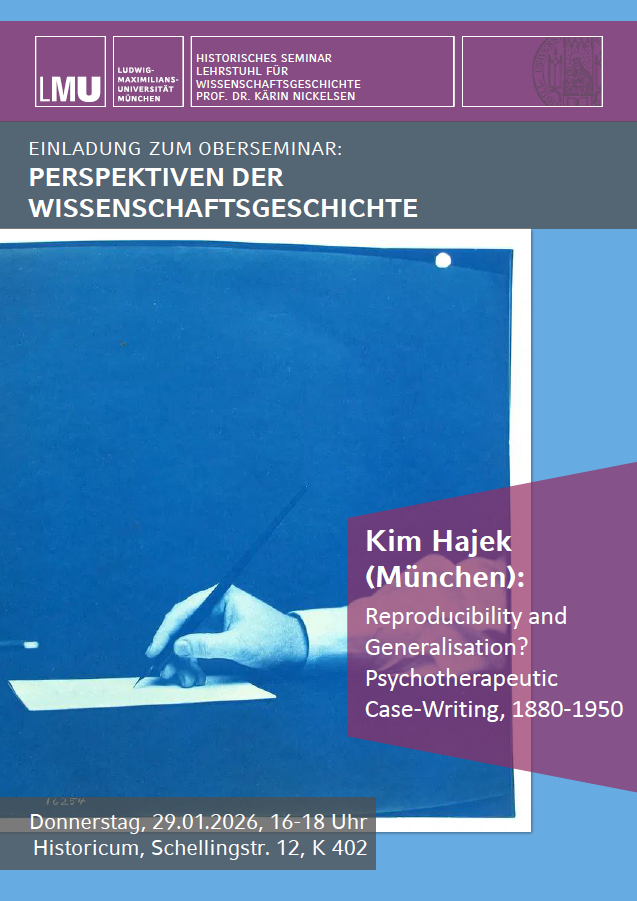
Ort: Historicum, Schellingstraße 12, K402
Zeit: 16-18 Uhr c.t.
Wir laden herzlich ein zu Kim Hajeks Vortrag "Reproducibility and Generalisation? Psychotherapeutic Case-Writing, 1880-1950":
What did therapeutic case-writing do for medico-psychological knowledge-making? While significant scholarship has examined what it means to ‘think in cases’ for the purposes of psychiatric diagnosis or accounting for extraordinary subjects, we know much less about the epistemic dynamics of case histories focused on therapy. Yet from the time Hippolyte Bernheim popularised the term ‘psychotherapy’ in the 1890s, collections of psychotherapeutic cases—sometimes more than 100 at a time—have been textualized and published, with the explicit aim of providing evidence in favour of a particular talking cure. These were highly situated narratives of a ‘talking’ encounter between patient and therapist, and of how the therapist adapted his words to that patient’s condition and ‘moral individuality’. On the one hand, it would seem relatively straightforward to report speech-based therapeutic moves in a case history; yet on the other hand, the importance of tailoring psychotherapy to an individual limits the potential for directly reproducing the therapeutic mechanism. In this talk, I present a new project interrogating the intersection of textual practices, therapeutic practices, and epistemic functions in psychotherapy case-writing, from Bernheim’s fin de siècle verbal suggestion to Carl Rogers’s 1940s client-centred therapy. Bearing in mind that these texts act and ‘move’ in in their own right, I investigate how their textual and narrative features play out as dynamics of individualisation, reproducibility, generalizability, and epistemic inclusion and exclusion. Is there a tension between accurately ‘datafying’ a therapeutic encounter and reproducing therapeutic expertise? To what extent do therapist-narrators direct their readers in similar ways to their interactions with patients? And are there embodied practices or intangible experiences that must be read between the lines of a case?
Der Vortrag findet im Rahmen des Oberseminars "Perspektiven der Wissenschaftsgeschichte" statt.