

Anna Mazanik (München)
02.07.2026
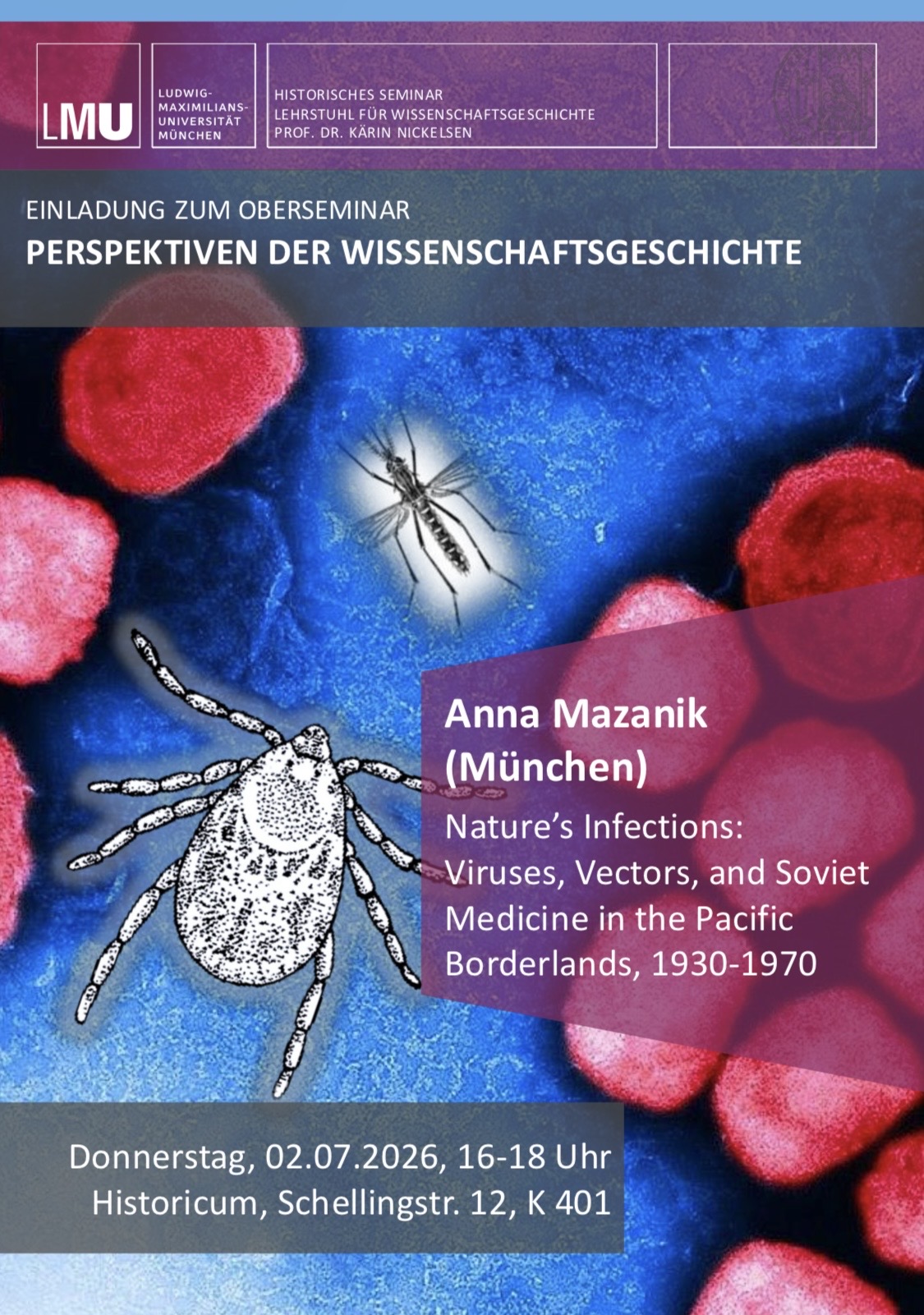
Ort: Historicum, Raum K401 Zeit: 02.07.26, 16-18 Uhr c.T.
Nature's Infections: Viruses, Vectors, and Soviet Medicine in the Pacific Borderlands, 1930-1970
The talk offers a history of the Soviet experience with two endemic diseases of the Pacific region—tick-borne encephalitis and Japanese encephalitis — in Primorie, Manchuria and on the Korean peninsula in the context of the colonization of the Far East as well as the Second World War and the Cold War. Early Soviet encephalitis research, including the isolation of the tick-borne encephalitis virus in 1937, has been crucial for the study of these diseases, both in Russia and internationally. However, I reveal that some of this early research has in fact been misrepresented in scientific literature and obscured by Soviet censorship. The secrecy of the Stalinist and to some extent also post-Stalinist era led to the silencing of the very distinct and epidemiologically relevant social, ecological and medical contexts. This political climate also affected the theoretical thinking of vector-borne infections, such as the natural nidality theory of transmissible diseases developed by Evgeny Pavlovsky. Although this theory offered a holistic ecological vision of disease and innovatively reimagined pathogens as natural components of ecosystems, I argue that it was also a political strategy of Stalinist science which allowed to talk about disease as part of nature without touching scientifically relevant but politically dangerous topics such as forced labor, malnutrition or deportations at the time of brutal state repressions.
Vortrag im Rahmen des Oberseminars "Perspektiven der Wissenschaftsgeschichte".